
No products in the cart.
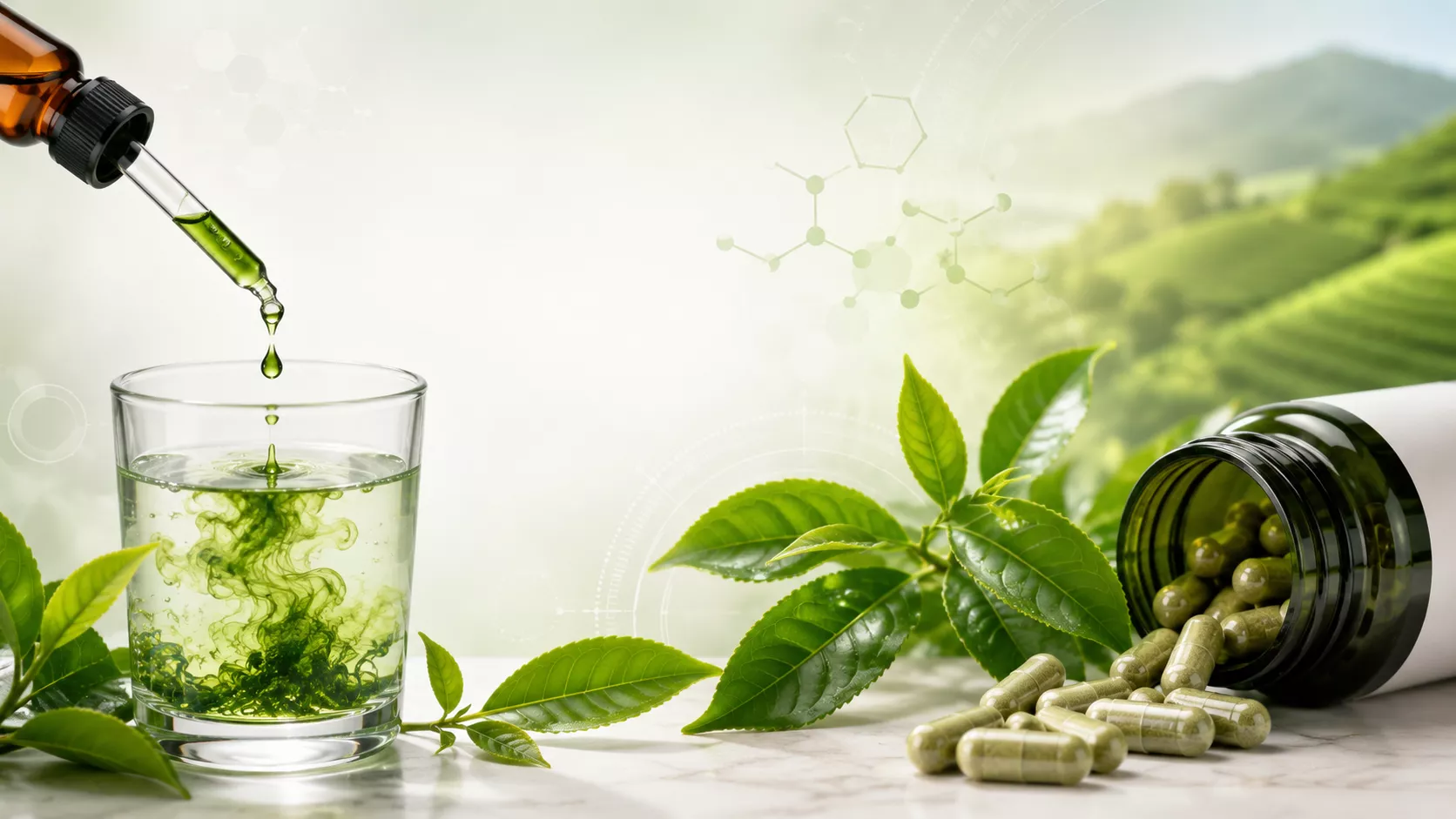
Liquid Green Tea Extract vs. Capsules: Which Is Better?
Quick answer: Both liquid green tea extract and capsules deliver the same active compounds — catechins like EGCG — but they behave differently in real life. Liquid wins on absorption speed and dose control; capsules win on convenience and taste masking. If you want flexible, fast-acting dosing, liquid is usually the better choice.
Comparing extract with a brewed cup rather than with capsules? That question is answered in full on green tea extract vs. brewed green tea.
Liquid vs. capsules: what actually differs
Green tea extract is a concentrated source of the antioxidants naturally found in green tea, standardized so each serving delivers a predictable amount of catechins. The extract itself is the same idea in either format — the difference is the delivery. A capsule wraps a dried powder in a shell your body has to break down first. A liquid extract is already dissolved and ready to absorb the moment it reaches your digestive tract.
What about loose green tea extract powder?
A capsule is only one way to take a powdered extract. The same dried powder is also sold loose, to be scooped into smoothies and shakes. To make it, manufacturers steep the leaves in a solvent — water, ethanol or ethyl acetate — filter out the plant matter, then spray-dry or freeze-dry the liquid into a fine powder. Spray-drying passes the concentrate through a high-temperature chamber, and that heat can take a toll on delicate catechins before the powder ever reaches a shelf. (We walk through every step, and why the solvent matters most, in how green tea extract is made.)
Loose powder also brings two practical problems capsules avoid. The first is dosing: a typical serving is only 250 to 500 milligrams, which really needs a digital micro-scale to measure, because kitchen spoons are far too imprecise and powder density shifts with humidity. The second is mixing: green tea extract powder is naturally hydrophobic, so it resists cold liquids and tends to leave bitter, dry clumps at the bottom of the glass. A liquid extract disperses instantly and is dosed by the drop.
Absorption: the case for liquid
Because a liquid extract skips the disintegration step, the catechins are immediately available — there is no waiting for a capsule to break apart. For compounds like EGCG, which can be sensitive to how and when they are taken, that head start can mean more consistent uptake from dose to dose. Capsules still absorb well for most people, but the process depends on stomach conditions and how quickly the shell dissolves.
Dose control and flexibility
This is where liquid pulls clearly ahead. With a dropper, you can fine-tune your serving — a little less on a lighter day, a little more when you want it — and adjust gradually as you learn what suits you. Capsules lock you into fixed increments; your only options are one capsule or two. If you are new to green tea extract and want to start low and build up, a liquid makes that effortless.
Taste, convenience, and routine
Capsules have one honest advantage: no taste. Green tea extract is naturally bitter and astringent, so a capsule hides that entirely, and it travels well in a bag or drawer. A quality liquid extract is designed to be mixed into water, juice, or a smoothie, which turns dosing into part of a daily drink rather than another pill to remember. Which matters more comes down to your habits.
Fillers, binders, and what is not in the bottle
There is one difference the absorption debate tends to skip: what has to be added to make each format work. Encapsulating a dried powder at scale generally calls for flow agents, lubricants, and binders — magnesium stearate, silicon dioxide, microcrystalline cellulose, stearic acid — plus the shell itself. Those are used in small amounts, but they add nothing nutritionally, and people with sensitive digestion sometimes notice them. A liquid extract needs none of it: the active green tea solids and a clean base such as purified water or vegetable glycerin. If you read labels for what is not in a supplement, that is the shorter list — and it is why we publish our laboratory test results and certificate of analysis instead of asking you to take it on trust.
Potency, freshness, and value
What you really want to compare is the standardized EGCG content per serving, not just the milligrams of extract — that number tells you how much active catechin you are actually getting. On value, liquids often stretch further because you control the exact dose rather than being tied to a pre-measured capsule. Whichever you choose, look for clear standardization, third-party quality practices, and a sensible use-by window so the catechins stay potent.
Shelf life: where powder has the edge
In an honest comparison, powder wins one category outright. Moisture drives chemical degradation, and a completely dry powder is very stable — kept cool, dark and dry, it can hold its potency for years. Catechins suspended in liquid are more exposed to light, air and heat, which is why many liquid supplements lean on alcohol or synthetic preservatives to extend their shelf life.
Chi Tea takes a different route. The leaves are processed and packed on-site in the Far East, then vacuum-packed and shipped in airtight, sealed vats, which limits their exposure to air on the way. The extract itself is made with a pure steam-water process — no alcohol, chemical solvents or preservatives. Once your bottle is open, keep it sealed, away from direct sunlight and heat, and use it within its recommended window.
| Feature | Green Tea Extract Powder (loose or in capsules) | Liquid Green Tea Extract |
|---|---|---|
| Absorption | Delayed — the powder (and any shell) must dissolve first | Already dissolved and ready to absorb |
| Dosing flexibility | Low — fixed capsule sizes or hard-to-measure loose powder | High — adjust drop by drop |
| Common additives | Silicon dioxide, magnesium stearate, maltodextrin | None needed in a water-based formula |
| Natural shelf stability | Excellent — a highly stable dry state | Moderate — depends on how it is sealed and stored |
| Solvent exposure | Often extracted with ethanol or ethyl acetate | Can be extracted with water alone |
So which should you choose?
Choose capsules if you value a fixed, tasteless, grab-and-go serving above all else. Choose liquid if you want faster availability, precise dose control, and the flexibility to blend it into your day. For most people focused on getting the most from every serving, liquid green tea extract is the more versatile format — which is exactly why Chi Tea is formulated as a standardized liquid you can dose to your needs and stir into whatever you are already drinking.
Frequently asked questions
Is liquid green tea extract better than capsules? For most people, liquid offers faster, more flexible dosing and does not rely on a capsule shell breaking down first. Capsules win on portability and taste masking.
Does liquid green tea extract absorb faster than capsules? Liquid is already dissolved, so there is no capsule to disintegrate first — which can mean quicker, more consistent uptake.
What is the best form of green tea extract? The one you will take consistently at a sensible dose. Liquid is ideal for adjustable dosing; capsules suit fixed, grab-and-go servings. Look for standardized EGCG either way.
How do I dose liquid green tea extract? Follow the label, start low, and adjust by the dropper. Take it with food and water.
Do green tea extract capsules contain fillers or binders? Usually yes — encapsulation typically requires flow agents and binders such as magnesium stearate or silicon dioxide, plus the capsule shell. A liquid extract needs only the extract itself and a clean carrier.
Does liquid green tea extract contain caffeine? Many commercial liquid extracts do. Chi Tea’s liquid green tea extract is caffeine-free — it is naturally decaffeinated with a pure water process, so you get the catechins without the jitters.
Does green tea extract powder dissolve easily in water? Not really. Pure green tea extract powder is naturally hydrophobic, so it resists cold liquids and tends to clump, while liquid extract drops disperse instantly in any drink.
Pingback: How to Use Liquid Green Tea Extract - ChiTea.net